Last night
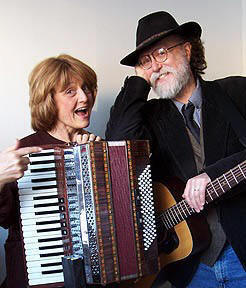
Lou and Peter Berryman performed on the UW campus, celebrating 30 years of some of the most singular, mind-blowing songwriting in human history, as well as the release of their new record,
The Universe: 14 Examples, and 30 years of folk music on Wisconsin Public Radio. The concert bounced back and forth between their earliest songs and their most recent, and between the think muscles, cry glands, and laugh cortex, binding them in synaesthesiac rapture.
How can I express how innovative, brilliantly constructed, and rewarding these songs are? I can't--not without at least the audible presence of the performers themselves, their odd, friendly, lovable personalities and vastly different, unique voices (a difference that imbues their polyphonic vocal interweavings with clarity). And not without Lou's meticulous music: melodies that can seem simple and straightforward until you try to sing them and begin to uncover their chromatic intricacy, their surprising twists and turns, the meaningful variation in degree of distance between pitches, the morphing, inversion and reversal of intervals that effectively answers the old question, "what if Schoenberg had written tonal folk music in the United States?"
But (to ask another of the old questions) is it folk? I can't answer that question without being able to play you the arrangements of Lou and Peter's songs. One recurrent problem in music (and perhaps especially in the nostalgic world of "folk as a genre") is the obsession with authenticity; if a songwriter is going to record a march or a tango, he or she generally does everything possible to give the song a "march sound" or "tango sound," bringing in extra musicians on the proper instruments for those genres, producing the record so that it sounds as much as possible like the most familiar marches or tangos. So the songwriter has simply added another set of lyrics to the same music we've heard before. The Berrymans are among the minority who know that the way to produce something new, an unheard-of folk music, is instead to bend the tools already at hand, to write for the accordion and guitar in forms they were never meant to inhabit. It makes every note count, makes it necessary to come up with fresh musical ideas, employs a genre as a skeleton or mask rather than a fashionable shirt ("playing a tango makes me look so good"). Part of the secret is in the instrumental melodies; Peter's 12-string rarely plays a full chord, instead interlocking with Lou's accordion to weave the fabric in the which the threads all stand out in their varied colors.
I can't express any of this, or even the wonderful consciousness that "funny" and "serious" are in no way opposites, that laughter and care go together and that this complexity is simple and direct because we live it (that it's only regarding art that there's a rigorous division made--another consequence of genre and of thinking of art as saying something about it's consumer, rather than to the people it encounters)--see, I can't express it without the songs. My sentences run off into obscurity. All I can venture here is a typology, a list of a few kinds of songs with reference to Peter's lyrics, and even that is misleading, since almost every song Peter writes is its own genre (actually, I've found that he writes in twos--there are a lot of songs that seem like pairs, often 15 or 20 years apart--but I can hardly think of any songwriter whose songs are that distinct from one another in their form and content).
1) The "pure language" song, like "The Similes," the first verse of which tells us that the Similes are flying by again in the sky, and the rest of which progresses symmetrically from single-word comparisons ("like flies/like hay") to elaborate compound images "like a bump on a log despite a notable night beside the beckoning beach without a suitable suit until the furniture guy arrives and everyone eats a pizza by the door beside the shore" and back to single words, the whole form imitating the expansion and contraction of a flock of birds, coming down to end on the unaccompanied "like ducks" (bird songs are a genre in their own right, and many make birds the icons of thoughts and words. For one that doesn't, see "
Some Birds"). Or "The History of Language," in which a story of a seaside picnic ends with the arrival of a century-old woman who sits down and begins to tell her tale--which turns out to be the same tale we've just heard, but in versions of English that move farther and farther into the past as the song progresses. See also "
Odd Man Out."
2) Close to this is the song that uses "pure" linguistic constraints to refer to the extra-linguistic, as in "
Bird Bird Bird." See also, in another sense, "
Artiste Interrupted."
(those clicking on the links will notice that my categories are already blurred)
3) The "conversation song." See "
Talkin' at the Same Time" (verses 2&3, 5&6, 8&9 are simultaneous), "
I Don't Believe You Like My Shirt," "
Orange Cocoa Cake," countless others.
4) The Wisconsin song. See "
The Limburger Ballad," "
Forward Hey."
5) The political satire. See "
Acme Forgetting Service," "
Elderlyville."
6) There's a category I don't have a succinct name for: the song that deals with daily life, the normal stuff, seen as weird. There's often an appreciation for simple existence in these songs that I find incredibly moving--and it's a theme that I usually can't stand in other people's work; it often seems to promote a love of comfort that blocks out everything else, shuts down the mind, a position of (in folk music) middle-class liberal privilege. Peter's lyrics in this vein, on the other hand, show a mind as active and unpredictable as any, and implicitly argue for a life kept strange, and thus outside various
statuses quo, always on its toes. I think this category and #1 might be my favorites. See "
We Don't Do It," "
When Did We Have Sauerkraut?," "
Red Kimono."
This post is way too long. All I wanted to do was express my thanks to Peter and Lou for their work. I can't think of many examples of people who've created a genuinely new art form by making their chosen field so capacious, opening it up to such a wide range of experience. That sounds like a good definition of the achievement of full humanity, and I hold it dear. Here's to another 30 years!
Labels: music